













Transaction Center
Time to bring it home. Find zipForm®, transaction tools, and all the closing resources you'll need. Except for the champagne — that's on you.
View the latest sales and price numbers. Find out where sales will be in upcoming months.
Get a roundup of weekly economic and market news that matters to real estate and your business.
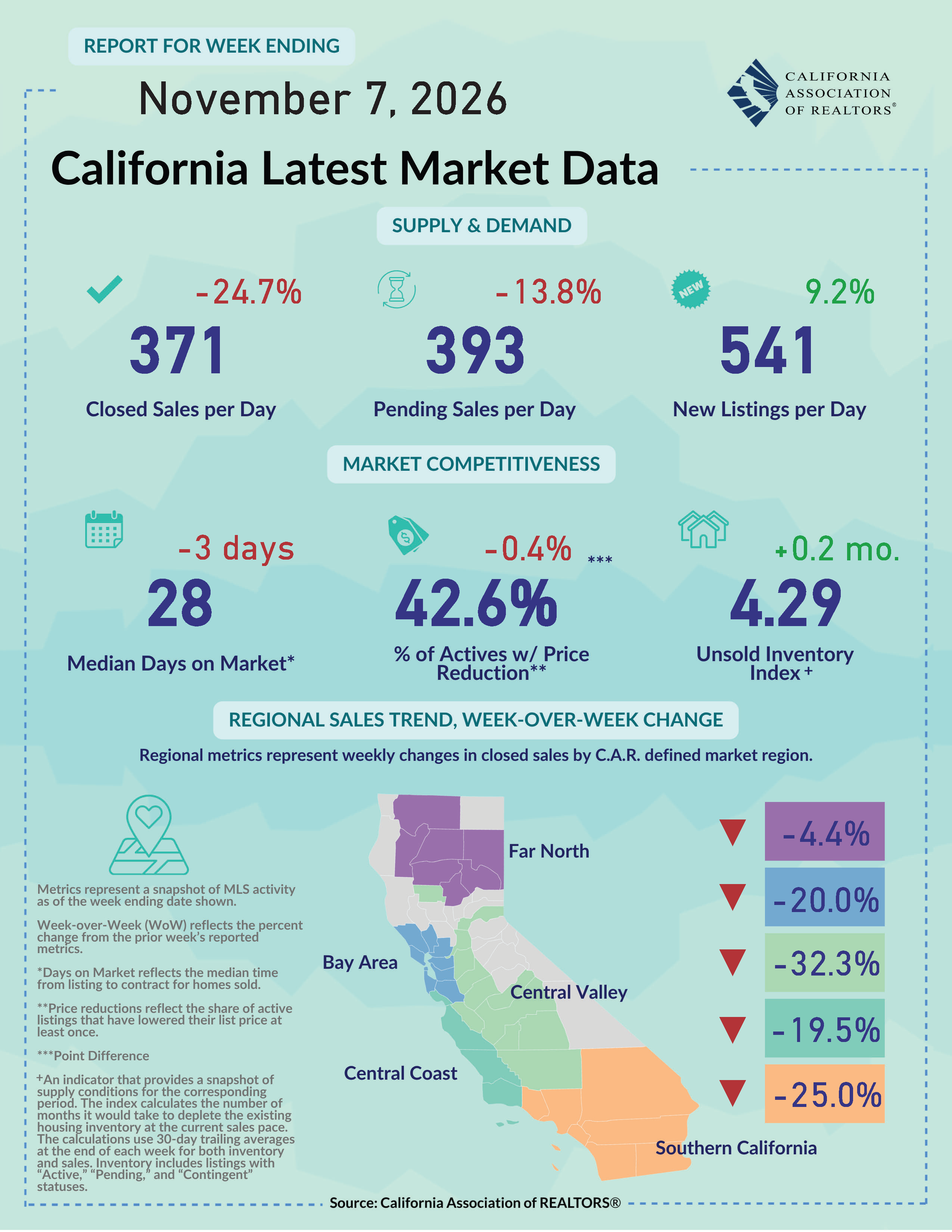
Gain insights through interactive dashboards and downloadable infographic reports.
All Shareable Reports All Interactive DashboardsCatch up with the latest outreaches and webinars by the Research and Economics team.
C.A.R. conducts research with members and consumers on a regular basis to get a better understanding of the housing market and the real estate industry.
California Model MLS Rules, Issues Briefing Papers, and other articles and materials related to MLS policy.
Looking for information on how to file an interboard arbitration complaint? You've come to the right place! Find the rules, timeline and filing documents here.
Information for members who serve as volunteers in C.A.R.'s Professional Standards programs
Summaries and photos of California REALTORS® who violated the Code of Ethics and were disciplined with a fine, letter of reprimand, suspension, or expulsion.
The most recent edition of the Code of Ethics and Standards of Practice of the National Association of REALTORS® along with other important links to NAR information.
The California Professional Standards Reference Manual, Local Association Forms, NAR materials and other materials related to Code of Ethics enforcement and arbitration.
Updates on C.A.R.'s legislative advocacy efforts in Sacramento.
Ballot MeasuresIssues briefing papers, handbooks and other background materials on local policy issues that affect real estate.
CREPAC, LCRC, IMPAC, ALF and the RAF comprise C.A.R.'s political fundraising arm.
The RAA: Protecting REALTORS® and Homeownership REALTOR® Action FundC.A.R. Senior Vice President of Government Affairs Sanjay Wagle discusses the end of the 2025-2026 Legislative Session.
Learn how you can make a difference, by getting involved yourself or by passing along valuable information to your clients.


California Housing Market Minute
Get the latest insights on California’s housing market with C.A.R.’s Market Minute. Follow key real estate trends, including home sales, prices, inventory, mortgage rates, and economic conditions affecting buyers, sellers, and REALTORS®.
Weekly Market Update
November 9, 2026
Recent data points to improving economic fundamentals, with October job growth well above expectations and third-quarter GDP accelerating to a 3.4% annual rate. Housing is showing encouraging signs as well, as California voters approved Prop 37 to expand homebuyer assistance, and fewer buyers reported difficulty obtaining insurance. Challenges will likely persist in the near term, but the outlook for the housing market appears modestly brighter heading into next year.
|
U.S. economy adds more jobs than expected in October. Employers in the U.S. added 165k jobs in October, well above the consensus expectations of 65k projected by economists. In addition to the strong jobs gain last month, August and September hirings were revised upward by a total of 84k in the latest report. Job creation remains broad-based, with professional and business services increasing 70k, while health care added 42k, and transportation and warehousing added 25k. Leisure and hospitality, on the other hand, reduced 13k jobs in October. The unemployment rate edged down to 4.1% last month from 4.2% recorded in September. Long-term employment rose sharply, however, with the average duration of unemployment jumping to 27.1 weeks, the highest level since September 2021. Those who have been unemployed for more than 27 weeks increased to 1.96 million, the most since December 2021. Overall, the report looks solid, and markets expect the Federal Reserve to move forward with another rate hike in December as Fed officials feel more confident about the current labor market conditions. Prop 37 gets overwhelming support, a major win for homeownership. California voters approved Proposition 37 and authorized the California Housing Finance Agency to issue up to $25 billion in revenue bonds to assist homebuyers with downpayment. Under the program, qualified buyers who must contribute at least a 3% downpayment themselves, can receive a second mortgage of up to 17% of the home’s purchase price to buy a newly built home. By providing the additional funding for eligible buyers, the program lowers the upfront barrier for many middle-income households and could lend them a big hand in achieving homeownership. Meanwhile, since the program is directed towards newly constructed housing, the measure strengthens the demand for new developments and could incentivize builders to bring more new supply to the market. The combination of demand-side assistance and new construction incentives will help increase homeownership opportunity and expand state’s housing stock simultaneously. Strong consumer spending and business investment accelerate economic growth in third quarter. Real gross domestic product (GDP) grew at a 3.4% annual rate in Q3 2026, outpacing the 2.2% gain recorded in the prior quarter, according to the latest release from the Commerce Department. Consumer spending continued to grow at a solid pace of 3.8% from July through September, while business investment jumped as artificial intelligence build-out boosted the surge. Gross private domestic investment increased 19.4% last quarter with nonresidential investment up 12.7% in Q3. Housing investment, however, was held back by elevated mortgage rates and dropped 3.3% from the prior quarter. The quarterly dip was the sixth in the last seven quarters. Government spending bounced back with a 15.8% increase but its contribution to the overall growth was partially offset by a dip in exports (-5.7%). Overall, the expansion in the third quarter GDP was encouraging but might also have given the Fed another reason for a rate hike as they focus more on inflation in the last meeting of 2026. Insurance accessibility is showing improvement, but affordability remains an issue. Fewer homebuyers had trouble obtaining insurance in 2026, with 18% reported having difficulties, down from 31% in 2024 and 26% in 2025, according to C.A.R.’s 2026 Housing Market Survey. The decline could be due to more buyers being aware of the issue and became better prepared, and their real estate agents may also have played a role by keeping them informed and financially ready. With the California Department of Insurance advancing regulatory and legislative efforts through the Sustainable Insurance Strategy, homeowners insurance availability and market stability have improved in the past year, but affordability for homebuyers remained an issue and has continued to deteriorate. In fact, over half of the buyers (54%) who encountered difficulties in obtaining insurance cited “premium being too expensive” as a major hurdle in getting coverage for their properties. The share of buyers who ended up with the FAIR Plan fell from 23% in 2025 to 16% in 2026, but premiums for many FAIR Plan policies are expected to increase starting in Q4 2026. While the situation is making progress, homeowners insurance remains an issue for California's housing market and will continue to weigh on home sales as premiums rise again in 2027. Construction spending falls as residential pulls back sharply in September. Total construction outlay pulled back in September, reversing most of the gains picked up in the prior month, as higher materials costs and elevated interest rates weigh on residential renovation projects. According to the latest data released by the Census Bureau, construction spending in September dipped 1.9% from August to $2,186.1 billion and was down 2.7% from September 2025. Residential construction dropped sharply by 5.4% month-over-month and plummeted 8.8% year-over-year from the same month in 2025. The steep decline was due primarily to a 13% drop in spending on remodeling from the prior month, while spending on both private single-family and multifamily construction remained essentially flat. Over the year, spending on all three categories were down, with remodeling dipping 18%, while both single-family construction (-2.4%) and multifamily construction (-0.2%) experienced much more moderate declines. Elevated interest rates and higher material costs remained the main culprits for the pull back in spending. With rates showing improvements in October, remodeling spending could pick back up in the next report, but ongoing uncertainty over building material tariffs will continue to have a negative impact on building activity in the coming months. Note: This summary report gets updated every Monday by 6:00 pm PST. Feel free to email us at [email protected] if you have any questions and/or feedback.
|
|